Why We Say Please to the Machine
We know it cannot be flattered or hurt. We do it anyway. The habit is a mirror.

Every day, millions of people type the word "please" to a machine that has no feelings, and "thank you" to one that keeps no score. We know it cannot be flattered and cannot be hurt. We do it anyway, often without noticing, and when we do notice we feel faintly ridiculous. It is a small habit, easy to laugh at, and worth taking seriously, because what it reveals is not about the machine at all. It is about us.
We cannot help seeing a someone
Human beings are relentless detectors of other minds. We evolved in a world where anything that responded to us was alive and probably mattered, and so we are exquisitely, almost helplessly, tuned to find a someone behind any behavior that looks like agency. We name our cars. We apologize to furniture we bump into. People felt a pang turning off a primitive chatbot decades ago. Now a machine answers us in fluent, responsive language, the single most powerful trigger our minds have for "this is a person," and the old circuit fires whether we authorize it or not.
Politeness was never really for the recipient. It is a posture we hold toward the world, and we cannot quite switch it off.
Our kindness runs so deep we cannot switch it off, even for a machine that keeps no score. The best of us, quietly leaking out.
We get used to treating a convincing imitation like a person, and slowly start treating real people like imitations.
What the habit actually is
Here is the gentle truth underneath it. When you say please to the machine, you are not making a considered judgment that it deserves courtesy. You are simply being unable, or unwilling, to switch off your own manners. That is not foolishness. It may be one of the better things about us, this reluctance to be rude even when rudeness would cost us nothing.
If we get used to treating a convincing imitation of a person like a person, the line we use to grant moral weight starts to blur. And it can blur in both directions.

And yet there is a worry
The hopeful direction is that our kindness expands. The worrying direction is the reverse: that as machines that merely sound like people become ordinary, we grow casually comfortable with the idea that sounding like a person and being one are the same thing, and quietly begin to extend less to the real people who happen, on a tired day, to sound a little less fluent than the machine.
The danger is not that we treat machines like people. It is that we might start treating people like machines.
Manners are what we do when no one is keeping score. The machine keeps no score, and still we say please. That is the whole of us, in one small word.
"But it is irrational, even a little wasteful"
The hard-nosed objection: the machine has no feelings to spare, so politeness toward it is pure superstition. Worse, it is not quite free. When someone asked Sam Altman what all the users typing please and thank you were costing OpenAI, his answer was tens of millions of dollars in extra processing. Every courteous word is real electricity spent on a recipient that cannot appreciate it. By cold logic, the please is waste.
True, and it misses what manners are for. Politeness was never a payment to the recipient, settled by whether they can feel it. It is a posture you hold toward the world, maintained mostly so you do not lose it. You do not say please to the machine because the machine deserves it. You say it because you are the kind of person who says it, and that person is worth keeping intact. The cost is the point, in a way: a courtesy that buys you nothing is the purest proof it was never a calculation. Drop it as irrational and you have not become more efficient. You have just practiced switching it off, and that is a muscle better left unpracticed.
Where this lands
We will keep saying please, and we probably should. The thing to hold onto is not whether we are polite to the machine, but whether we still remember the difference between the thing that merely sounds deserving and the person who actually is.
I write about AI, data, and learning regularly at pinaldave.com, and I have been teaching this hands-on in my AI workshops.
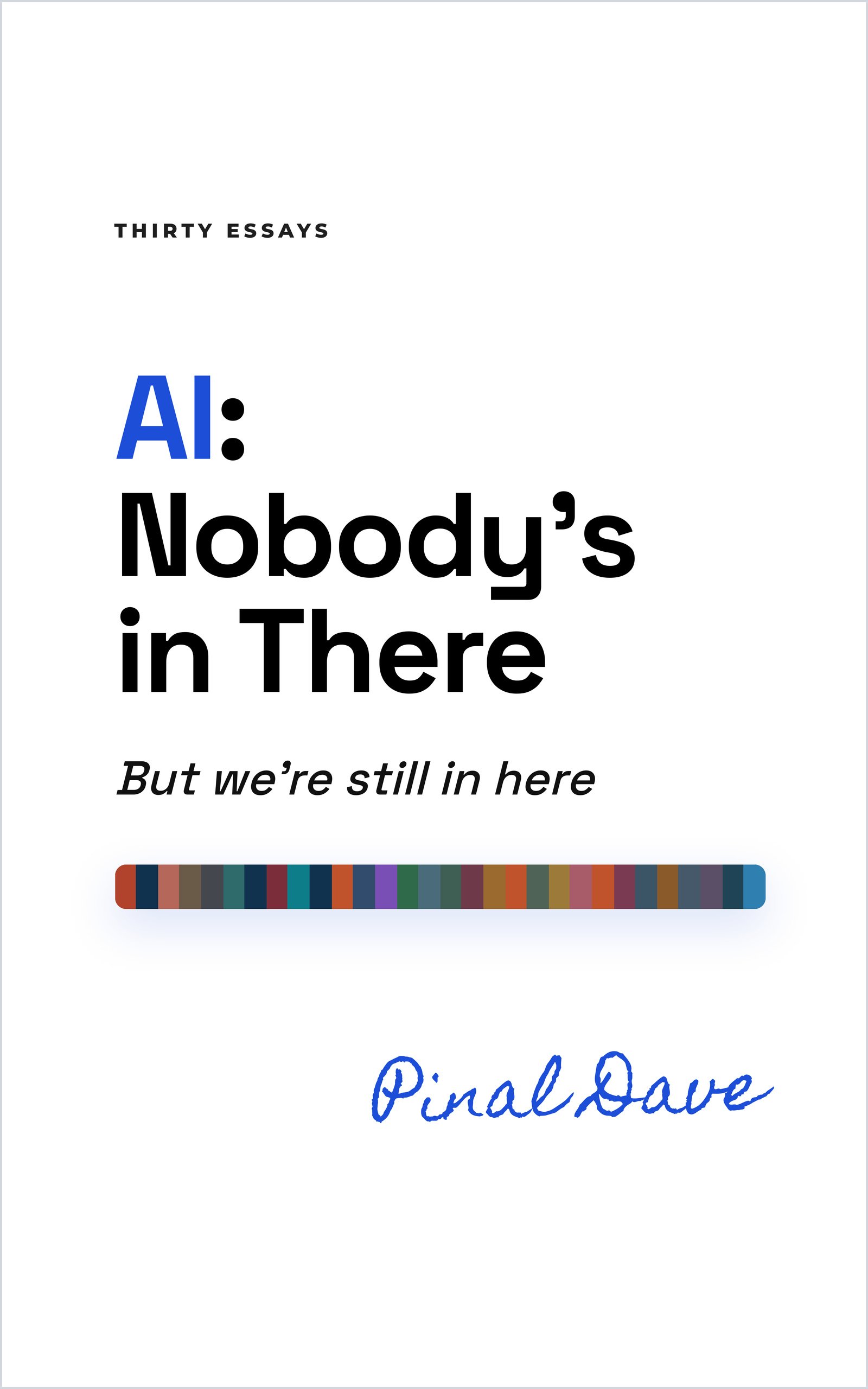
Take the full collection with you.
AI: Nobody's in There is available on Amazon as a Kindle eBook, audiobook, and paperback.